Why Good Artists Simplify Drawing and Beginners Overcomplicate It - How 3D References Improve Your Thinking
Most beginners don’t struggle because they “can’t draw.” They struggle because they see too much at once. Faces become details, bodies become anatomy charts, objects turn into a mess of lines instead of simple forms. Good artists don’t work harder than beginners. They just remove what’s unnecessary earlier in the process.
And this is where simplification in drawing actually happens - not at the end, but at the very beginning of how you see.
I used to overcomplicate everything I drew. Every time I started a sketch, I would immediately get lost in details - folds, edges, tiny shapes, random shadows that I didn’t even understand yet. I thought that was “being accurate,” but in reality it just made my drawings stiff, messy and frustrating.
What changed things for me was learning how to simplify drawing properly - and honestly, 3D references played a huge role in that shift. They didn’t magically make me better, but they forced me to slow down and actually understand what I was drawing instead of just copying what I saw.
And that’s where everything started to click.
Why beginners overcomplicate drawing
When someone starts learning drawing, the instinct is to copy what they see exactly.
Every wrinkle. Every shadow. Every small curve.
But here’s the problem: the brain cannot handle all visual information equally. So beginners often:
- focus on outlines instead of structure
- chase details before proportions are correct
- try to “finish” too early
- lose the big shape because of small distractions
The result is a drawing that feels tight, stiff and confusing - even if the intention was accuracy.
Overcomplication is not a skill issue. It is a thinking habit.
When you’re starting out, it feels natural to treat drawing like copying reality as closely as possible. You look at an object or a figure and try to include everything you see. The problem is that the human brain is not built to handle visual information that way in a structured drawing process.
So what happens is predictable:
You jump into details too early. You start rendering areas that are not even correctly placed. You focus on outlines instead of structure. And slowly, the drawing loses clarity because there was never a clear foundation in the first place.
Overcomplicating drawing usually comes from good intentions. You want it to look real, you want it to look detailed, you want it to look finished. But without structure, detail doesn’t add realism - it just adds noise.
What good artists actually do differently
Experienced artists do something almost opposite. They don’t start with detail. They start with structure.
Before anything else, they reduce what they see into:
- big simple shapes
- basic proportions
- clear angles and directions
- volume instead of surface
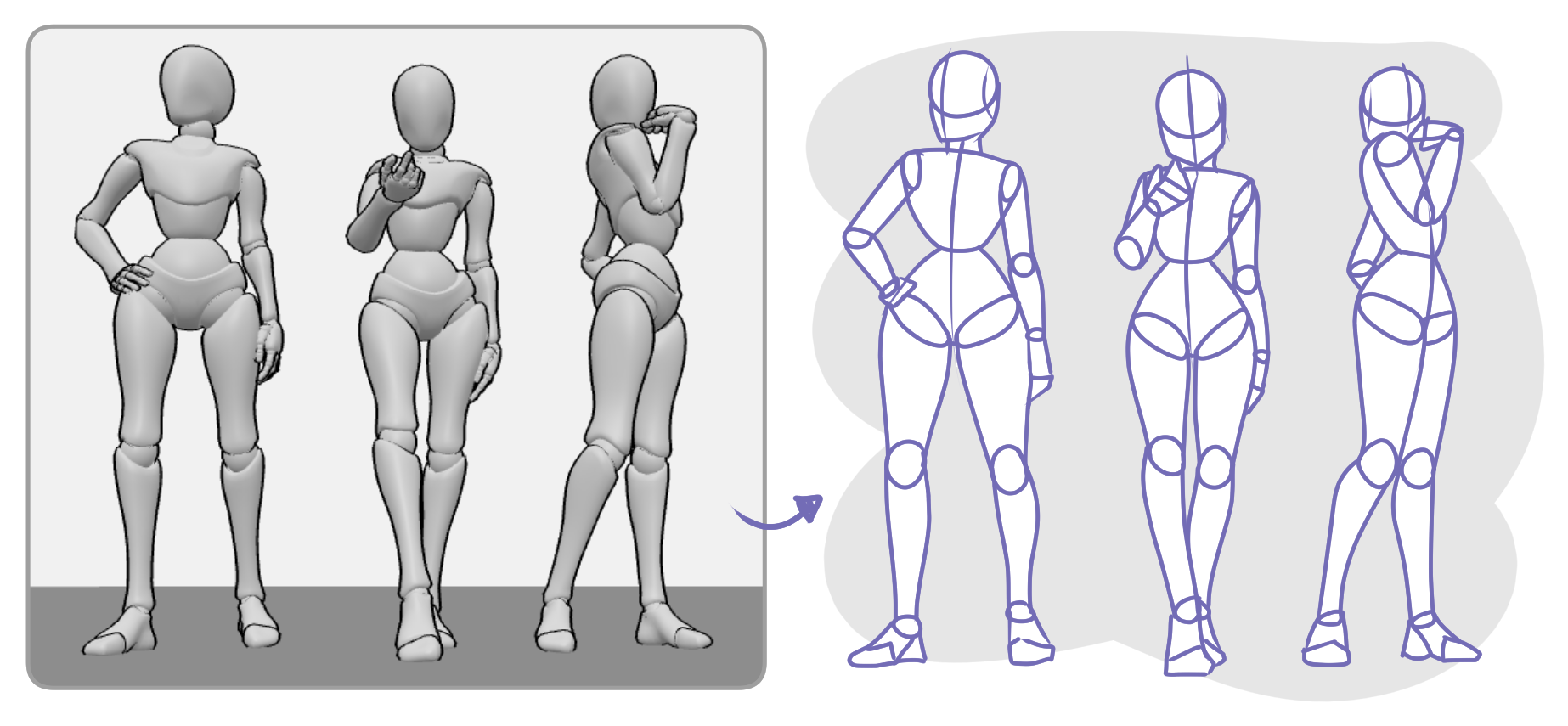
A head becomes a circle and a simplified jaw structure.
A body becomes cylinders and blocks.
A complex pose becomes a few directional lines.
This is what “simplify drawing” really means:
not drawing less, but thinking in fewer visual units.
Good artists don’t start with what they see. They start with what they understand. Instead of thinking in terms of “eyes, nose, mouth” or “shirt folds and fingers,” they think in simple forms and relationships. They reduce complexity immediately, not at the end of the process, but at the very beginning.
This isn’t simplification as a final step - it’s simplification as a thinking method. It creates a kind of mental filter where unnecessary information gets removed early, so the drawing stays readable from the start. And once you start working like this, you realize something important: clarity is not something you add later. It is something you build first.
Where 3D references change everything
This is the point where most learners get stuck:
they understand simplification in theory, but not in practice.
This is exactly where 3D references become powerful.
A 3D reference removes the biggest beginner problem: ambiguity.
Instead of guessing:
- perspective
- form rotation
- light direction
- volume relationships
you can actually see the structure clearly from any angle.
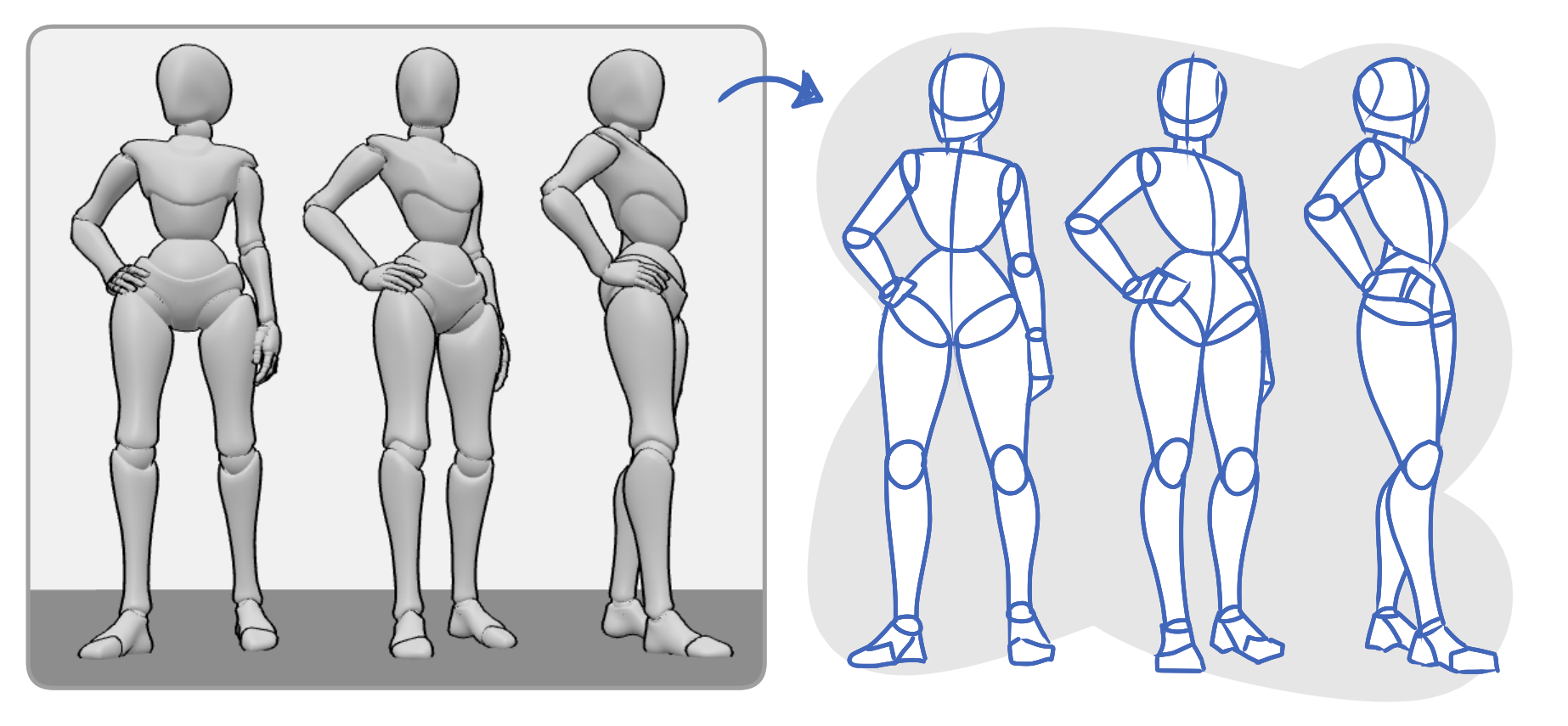
This trains something extremely important:
your brain starts recognizing forms instead of copying outlines.
3D references were a turning point for me because they made structure visible in a way imagination never could.
When I was only drawing from 2D images or imagination, I constantly guessed. I wasn’t sure how forms rotated in space, how perspective actually worked in complex poses, or how volumes interacted with each other. That uncertainty led to overthinking, and overthinking led to overcomplication.
With 3D references, that uncertainty started to disappear.
Suddenly, I could rotate the subject, see it from different angles, and understand how simple forms build up complex shapes. Instead of guessing where something goes, I could observe it directly. That alone reduced a huge amount of mental noise in my process.
But more importantly, it changed how I think even when I’m not using references. My brain started recognizing underlying forms instead of just surface details. That shift is subtle, but it completely changes how you draw.
How 3D references train simplification in practice
The real benefit of 3D references is not that they “make drawing easier.” It’s that they train your eye to automatically simplify.
When you regularly study or build scenes in 3D space, you start to notice patterns:
- Complex objects are just combinations of simple volumes.
- Human anatomy can be broken down into repeatable shapes.
- Perspective becomes a relationship between forms, not lines on a page.
This flexibility is what makes 3D references such an effective training tool. You can intentionally remove detail instead of being overwhelmed by it.
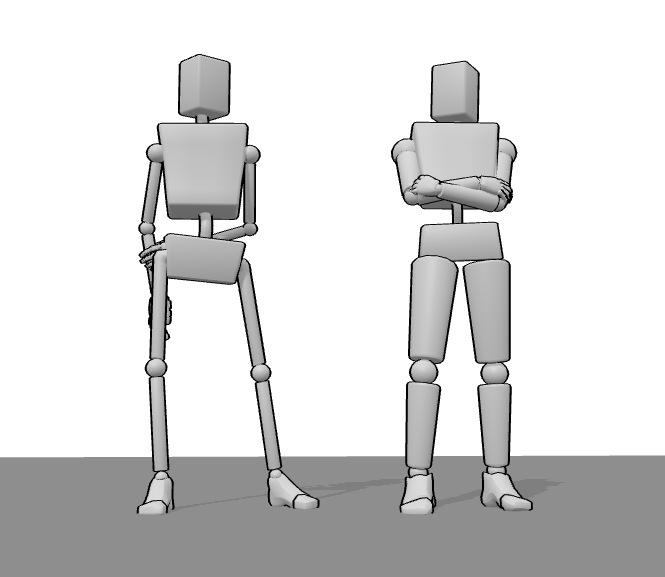
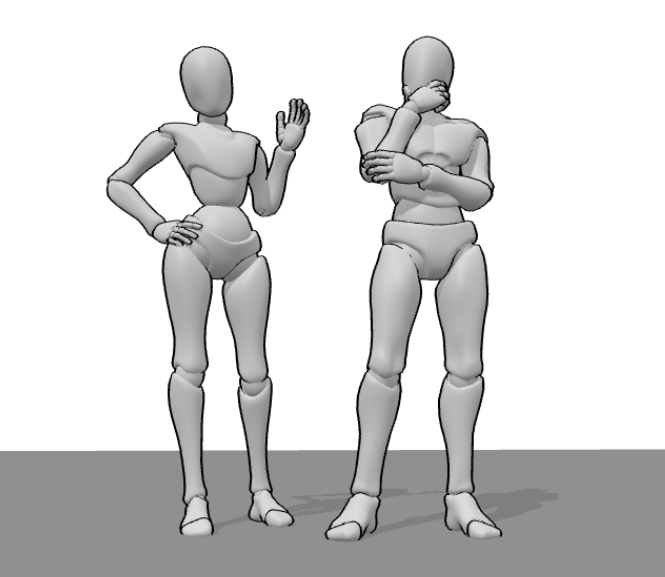
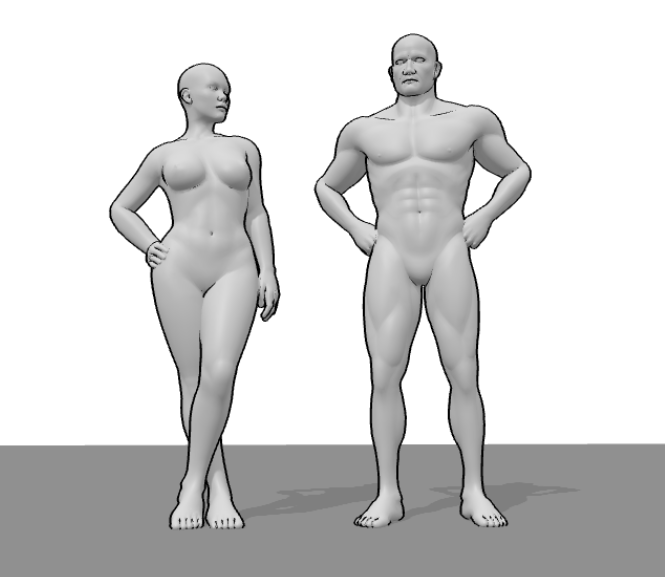
In PoseMyArt, you can switch between different model types to match what you want to study, from simple stick figures to more structured or anatomical forms.
Want to study balance? Use a stick or blocky model.
Want to understand volume? Switch to simplified forms.
Need anatomy clarity? Bring in the skeleton.
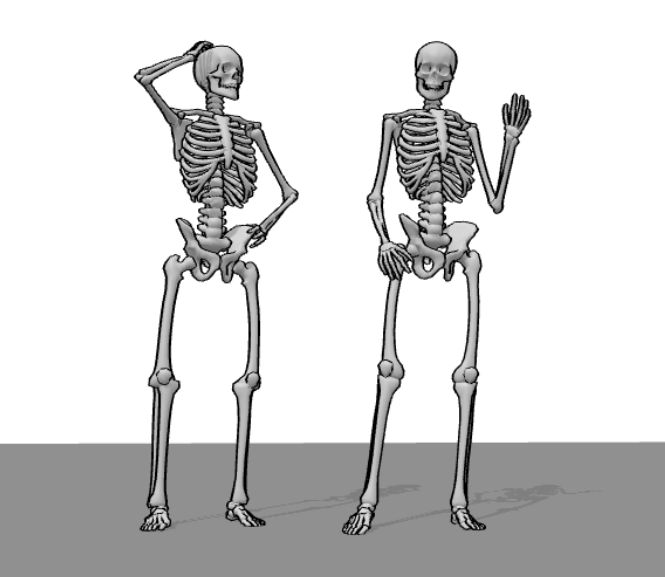
After building a solid structure, moving to a realistic model helps you explore details and bring everything together.
Over time, you stop reacting to what you see and start interpreting it. Instead of copying a contour, you ask what kind of form creates that contour. Instead of shading randomly, you think about how light wraps around a simple volume.
This is where real improvement happens - not in rendering, but in perception.
The real skill: seeing simply
Simplifying drawing is not about drawing less detail.
It is about delaying detail until structure is correct.
Good artists don’t suppress complexity - they organize it.
And 3D references accelerate this because they force clarity. There is no guessing where the form goes, no mental distortion from imagination alone.
You learn to trust structure over surface.
That is the turning point.
Why simplification feels uncomfortable at first
One of the biggest traps for beginners is thinking that simple drawings look “wrong” or “unfinished.”
At the beginning, simplifying feels wrong.
A sphere instead of a head feels too basic.
A box instead of a torso feels too crude.
A stick structure feels “unfinished.”
But this discomfort is actually part of the process. You are not reducing quality - you are removing noise. And at first, your brain interprets the absence of noise as something being wrong.
The truth is the opposite: clarity often looks empty before it looks correct.
Once you push through that phase, you start to see that complexity is not the goal. Readability is.
How to practice simplification properly
If you want to train this skill effectively, don’t aim for perfect drawings first. Start with structure, not detail.
Instead, focus on this order:
- Start with simple 3D forms (boxes, spheres, cylinders)
- Place proportions before details
- Rotate mentally or in 3D reference space
- Only then add surface information
When using 3D references, don’t treat them as something to copy. Treat them as something to analyze. Pause and ask yourself:
What is the simplest form here?
How would this object exist in space without detail?
Can I rebuild this with just a few shapes?
That mindset alone changes how you draw.
The real shift that separates beginners from artists
At some point, drawing stops being about what you see and becomes about how you think.
Beginners try to include everything.
Artists choose what matters and ignore the rest.
And that difference shows up immediately in the clarity of the work.
3D references don’t just improve accuracy - they train that way of thinking. They push you away from surface-level copying and toward structural understanding.
Once that shift happens, simplification stops being something you struggle with. It becomes your default approach.
Final thoughts
Good artists don’t see more.
They see less - but more clearly.
They don’t simplify because they are missing information, but because they understand what actually matters and what can be ignored.
Beginners often try to capture everything at once, which leads to overload, confusion and unclear drawings. The more they try to include, the less readable the result becomes.
3D references help bridge this gap by making structure visible and reducing uncertainty. Instead of guessing, you start to see how forms exist in space, how they connect, and how they simplify into something understandable.
And when uncertainty disappears, simplification stops being something you force. It becomes natural - a way of thinking, not just a drawing technique.
That is the real reason good artists simplify drawing - and why beginners overcomplicate it.