Why Drawing Teeth Is So Hard - And How 3D References Actually Help
Teeth are one of the smallest elements in a face - and one of the easiest ways to ruin an otherwise solid drawing. I’ve lost count of how many times I finished a portrait, liked everything about it, then added teeth and immediately felt something was wrong. The expression turned stiff. The smile looked forced. The character suddenly felt lifeless.
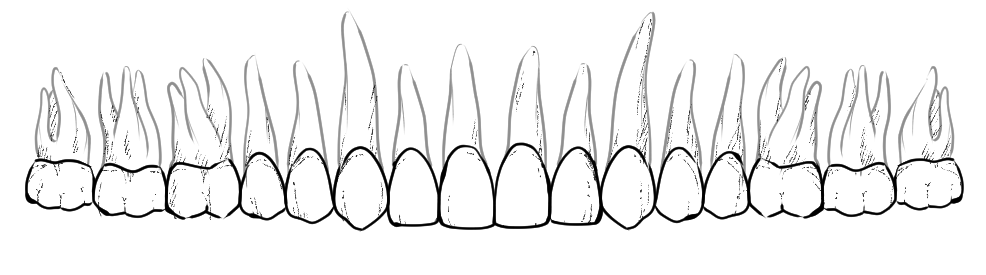 The problem usually isn’t detail. It’s structure. Most artists don’t struggle with teeth because they can’t draw them - they struggle because they try to draw individual teeth instead of a unified form. And this is exactly where understanding structure, proportions, and 3D space makes all the difference.
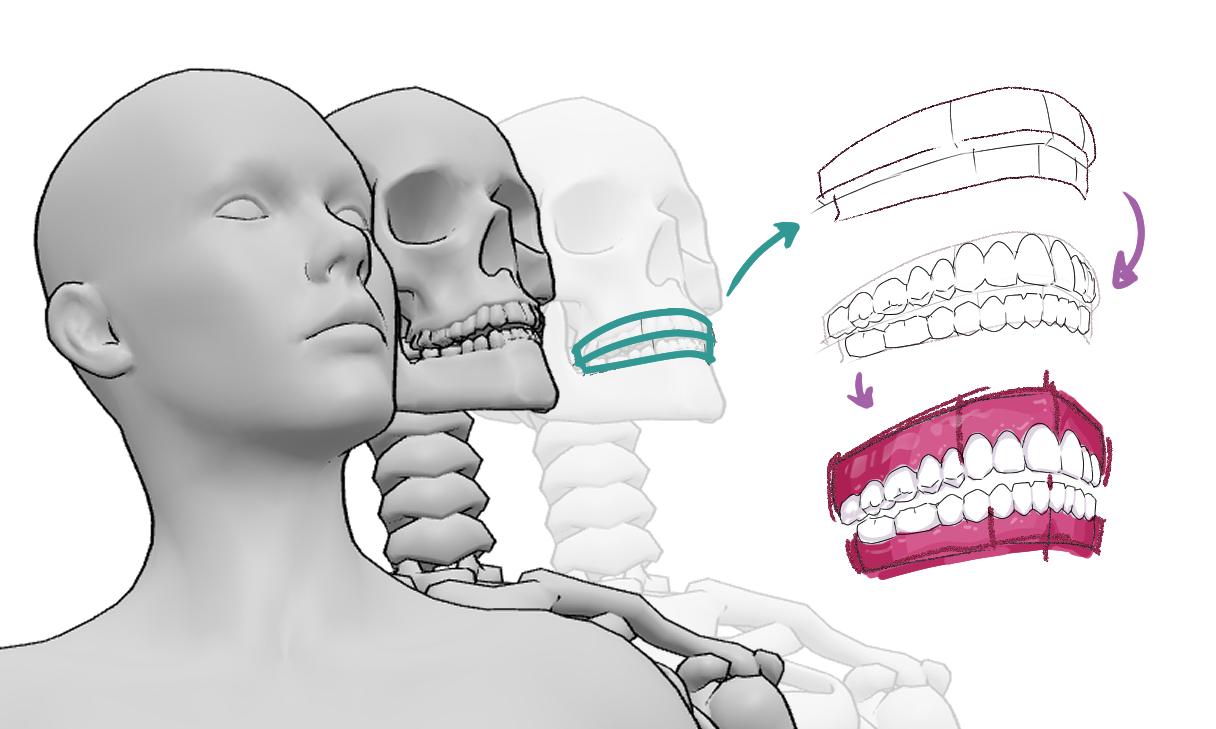
The skeleton model allows you to study what actually supports the face: the skull, the jaw, and the teeth themselves. By switching to the skeleton model in PoseMyArt, you can clearly see how the dental arch curves inside the jaw, how upper and lower teeth relate to each other, and how facial proportions are built on bone structure. This structural clarity makes it much easier to place teeth convincingly later - even when drawing in a stylized or simplified way.
- The Most Common Problem: Teeth Floating Inside the Face
- Think in Shapes, Not Individual Teeth
- Why Head Angle Matters More Than Tooth Detail
- How 3D Reference Models Actually Help When Drawing Teeth
- Basic Teeth Anatomy and Morphology for Artists
- Drawing Teeth in Different Art Styles
- How to Reach a Natural Look (and Avoid a Scary One)
- Why This Matters Even More in Stylized Drawing
The Most Common Problem: Teeth Floating Inside the Face
One of the biggest mistakes I see (and used to make myself) is treating teeth like a flat row of rectangles placed inside the mouth. When this happens, teeth feel disconnected from the jaw, lips, and skull.
This usually leads to:
- Smiles that look pasted on
- Teeth that are too large, too even, or oddly centered
- Expressions that feel stiff or unnatural
What’s missing is context. Teeth don’t exist on their own - they sit inside a curved jaw, influenced by skull structure, head angle, and facial proportions.
Think in Shapes, Not Individual Teeth
A useful mindset shift is this: Don’t draw teeth. Draw the dental arch.
Before thinking about individual teeth, block them in as:
- One curved mass for the upper teeth
- One curved mass for the lower teeth
This instantly solves many issues:
- Perspective becomes clearer
- Teeth follow the curvature of the face
- The smile integrates naturally with the jaw
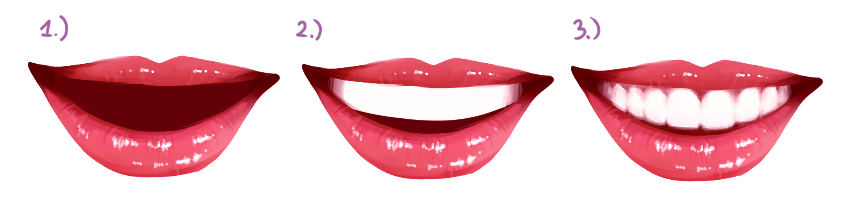
Only after this structure feels right should you hint at individual teeth - and even then, less is more. In most cases, suggesting separation with subtle value changes works better than outlining every tooth.
Why Head Angle Matters More Than Tooth Detail
Another common issue is drawing correct teeth for the wrong angle. A smile seen from the front, from below, or in three-quarter view will drastically change how much of the upper or lower teeth you see.
This is where many drawings break: the teeth are frontal, but the head isn’t.
Understanding how the jaw rotates in space is crucial - and this is where 3D references quietly become one of the most powerful tools for drawing teeth accurately.
How 3D Reference Models Actually Help When Drawing Teeth
Teeth become difficult to draw the moment we lose orientation in the face. Most errors don’t come from misunderstanding teeth themselves, but from misplacing them inside the head.
This is where 3D reference models become invaluable.
When working with posed 3D heads in PoseMyArt, the first major advantage is clarity of structure. The jawline is clearly visible from any angle, which immediately defines where the teeth can exist. Teeth always sit inside the jaw volume - never floating, never centered arbitrarily.
From there, you can:
- Clearly see the jaw angle
- Draw the middle line of the face accurately
- Align the dental arch to the head’s rotation
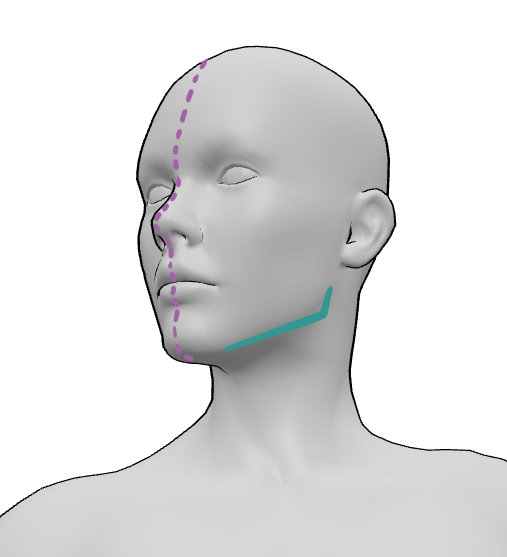
That center line is crucial. Once it’s placed, positioning teeth becomes a logical decision instead of a guess. The dental arch follows the jaw, which follows the skull. Everything connects.
An even bigger breakthrough comes when switching to skeleton model:
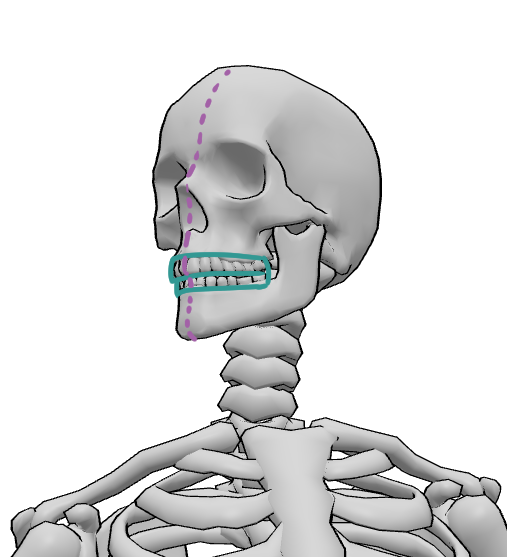
Now the teeth are visible in their real anatomical position. You can study:
- The curved shape of the dental arch
- How upper teeth overlap lower teeth
- How teeth sit deeper than we usually imagine
This alone eliminates one of the most common mistakes: drawing too many teeth, too evenly, too front-facing.
Basic Teeth Anatomy and Morphology for Artists
You don’t need to study dentistry to draw believable teeth, but understanding basic anatomy and tooth morphology will greatly improve your results. For artists, the most important focus is the front teeth, since these are the ones most often visible and expressive in drawings.
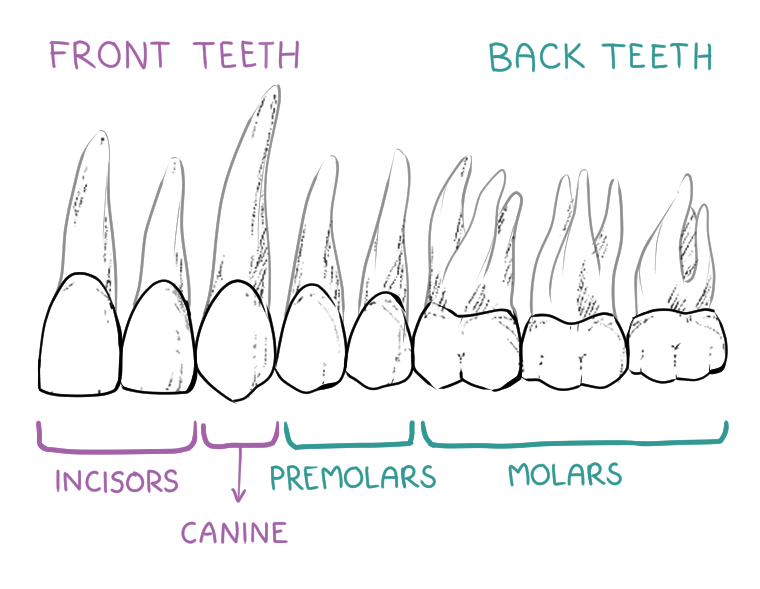 The incisors and canines define the overall shape and rhythm of the smile. Their size, spacing, and subtle differences in width and height are what give a mouth character and realism. These front teeth are worth studying individually, as small variations here strongly influence expression and personality.
Premolars and molars, on the other hand, are usually only partially visible or completely hidden by perspective, lips, and the curve of the dental arch. Because of this, artists rarely need to draw them in detail. It’s still useful to understand that they exist and how they support the overall curvature of the mouth - but in most cases, they can be suggested as simplified shapes or omitted entirely.
By focusing on the morphology of the front teeth while keeping the rest structurally implied, you can achieve natural, convincing smiles without over-rendering or unnecessary complexity.
How Much Teeth Are Visible in Different Expressions
Teeth visibility changes dramatically depending on expression. Understanding this alone improves realism instantly.
- Neutral face: teeth usually not visible
- Relaxed smile: upper teeth slightly visible, often only the center ones
- Wide smile: upper teeth dominate, lower teeth may barely show
- Forced smile: too many teeth, often looks unnatural
- Laughing: mouth opens vertically; teeth follow jaw angle
- Angry / tense expressions: teeth often clenched or partially hidden
Key rule: If you see every front tooth clearly, the smile is probably unnatural.
Types of Smiles Artists Should Practice
Not all smiles are equal - and drawing the wrong one causes the infamous “creepy smile” effect.
Practice these types:
- Closed-lip smile
- Soft open smile
- Asymmetrical smile (more natural than perfect symmetry)
- Wide expressive smile
- Subtle grin
The most natural smiles are slightly uneven. Perfect symmetry is the enemy of believability.
Drawing Teeth in Different Art Styles
Realistic
- Teeth are suggested, not outlined
- Individual teeth rarely need full separation
- Values do more work than lines
Semi-stylized
- Simplify teeth into grouped shapes
- Emphasize the curve of the dental arch
- Use fewer vertical divisions
Stylized / Cartoon
- Teeth may become a single shape
- Focus on expression over anatomy
- Still follow jaw direction and center line
No matter the style, the underlying structure stays the same.
Stylization exaggerates - it does not replace anatomy.
How to Simplify Tooth Shapes Effectively
Instead of drawing 28–32 teeth:
- Let lips hide most of the detail
- Start with one curved block
- Divide only where necessary
Think: suggestion, not description.
How to Reach a Natural Look (and Avoid a Scary One)
Most “scary” teeth happen because of:
- Too much contrast
- Too many outlines
- Teeth placed too far forward
- Teeth ignoring head perspective
To keep it natural:
- Reduce contrast
- Let lips overlap teeth
- Follow jaw rotation
- Hide more than you show
If the teeth are the first thing you notice, they’re probably overdone.
Why This Matters Even More in Stylized Drawing
Proportion issues with teeth become more noticeable in stylized or semi-realistic art. Exaggerated features amplify mistakes. A slightly off jaw angle or tooth placement can instantly break the illusion.
This is why structure matters more than realism. Once the underlying relationships are solid, you can simplify, exaggerate, or stylize freely - without the drawing falling apart.
Drawing teeth becomes easy once you stop treating them as isolated objects.
They belong to the jaw. The jaw belongs to the skull. The skull defines perspective.
3D reference models don’t teach you how to draw - but they remove confusion. They give you spatial truth. And teeth demand spatial understanding more than almost any other facial feature.
When structure is right, style becomes freedom. When structure is wrong, no amount of detail can save the drawing.
Final Thoughts
Drawing teeth isn’t about mastering detail.
It’s about understanding where teeth sit in the face, how they follow the jaw, and how they behave in perspective.
3D reference models don’t replace observation or skill - but they remove unnecessary guesswork. They give you spatial clarity, which is exactly what teeth demand.
If you’ve ever felt that your drawings look great until you add a smile, you’re not alone. Fixing teeth starts with structure - and once that clicks, everything else becomes easier.