Mastering Leg Anatomy: How 3D Pose References Make It Easier to Draw Legs
Drawing legs is one of those skills that looks simple from a distance, but quickly becomes frustrating the moment you try to construct them from scratch. Proportions feel off, knees don’t sit right, and the connection between hips and feet often collapses visually.
The problem is rarely anatomy knowledge alone. It’s structure. This is where 3D pose references change everything.
- Why Legs Feel So Difficult to Draw
- How 3D Pose References Solve the Problem
- Understanding the Skeleton First
- Female and Male Leg Structure Differences
- Muscle Groups That Actually Matter
- The Knee: The Most Misunderstood Joint
- Feet and Ground Contact: Where Most Drawings Fail
- How to Practice with 3D Pose References
- Why This Method Works
Why Legs Feel So Difficult to Draw
Legs are not simple tubes. They are a complex system of:
- overlapping muscle groups
- shifting weight distribution
- changing proportions depending on pose
- constant interaction with the ground
Unlike the arms, legs carry the entire body. That means even a small mistake in angle or balance can make the whole figure feel unstable.
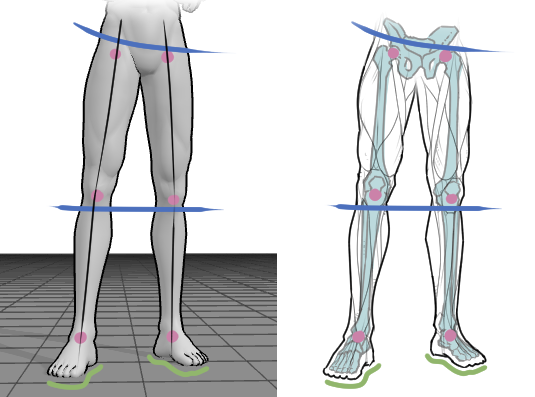
Most drawing struggles come from trying to “guess” this structure instead of seeing it clearly.
How 3D Pose References Solve the Problem
3D pose references remove uncertainty from drawing legs.
Instead of relying on memory or guesswork, you’re working with a fully structured body where the legs exist in real space, carry weight, and interact with perspective in a clear, readable way.
Legs are especially unforgiving. A small mistake in the thigh angle, knee placement, or foot direction doesn’t stay local - it destabilizes the entire pose. Balance breaks. Movement feels fake.
With 3D references, the problem shifts.
You’re no longer inventing the leg.
You’re learning to observe, adjust and decide.
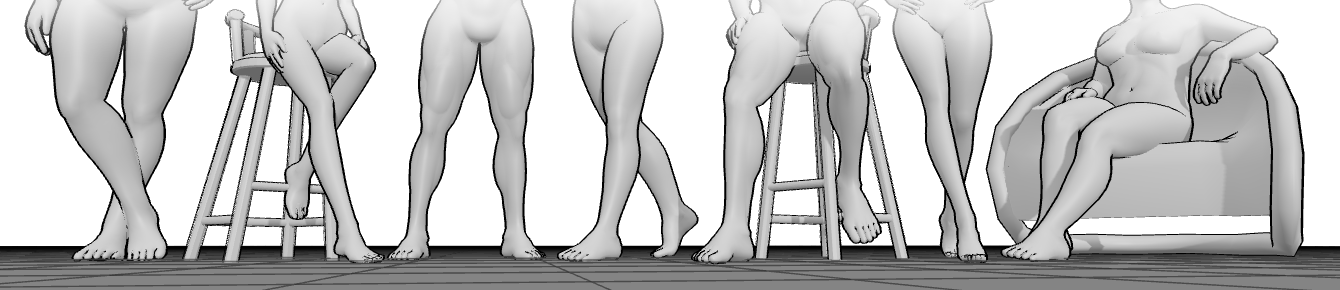
Another major advantage is variety.
You’re not studying a single idealized leg, but many different leg structures across multiple body types and poses.
Slim, curvy, muscular, heavier builds - each model distributes mass and proportion differently, and different poses change how that structure is stressed, compressed, or extended. Seeing these variations side by side makes it much easier to understand what actually stays consistent in leg anatomy, and what shifts depending on both body type and movement.
This is especially important for drawing legs, because proportion and balance errors become obvious very quickly. Studying multiple models in varied poses trains your eye to recognize structure in action, instead of memorizing a single static look. This understanding is what makes 3D references practical in real work. Once you’ve trained your eye on different body types and poses, the reference stops being just something you study and becomes something you actively use.
When a leg in your sketch feels wrong, you’re no longer guessing. You have a clear comparison point. You can quickly check proportions, angles, knee direction, and how the foot meets the ground - and correct the issue before it gets baked into the drawing.
Understanding the Skeleton First
Before muscles make sense, the skeleton defines everything.
| 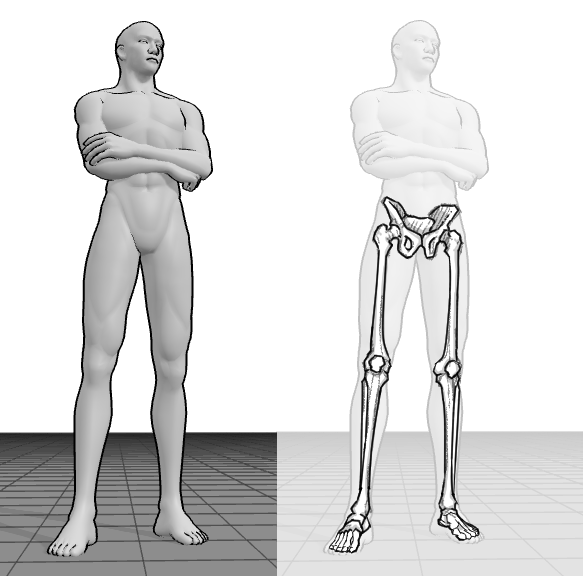 |
The leg is built around a simple but critical system:
- pelvis as the anchor
- femur as the main load-bearing bone
- knee as a hinge with slight rotational complexity
- tibia and fibula shaping the lower leg
- ankle as the final transfer point into the foot
If the skeleton is wrong, everything above it collapses visually.
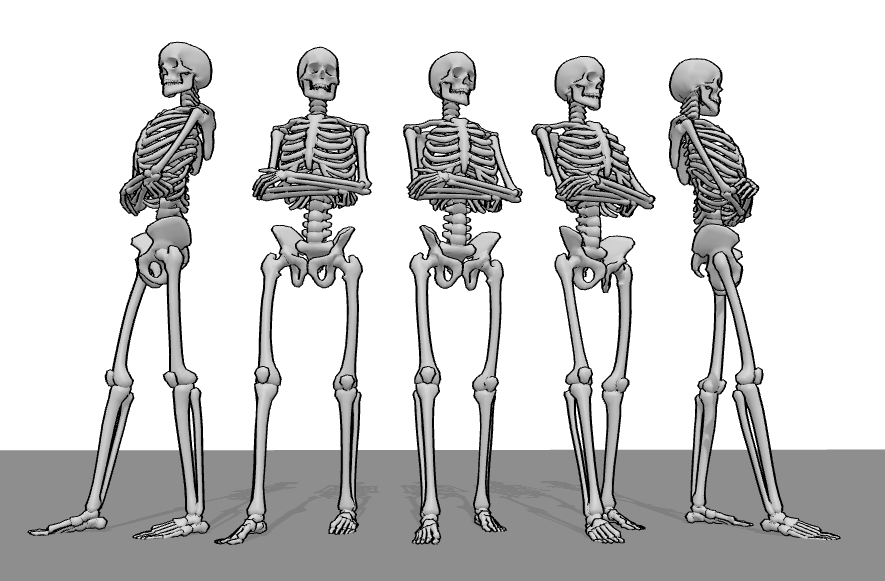
3D pose references allow you to rotate and observe this structure from any angle, which is something flat reference images can’t provide.
Female and Male Leg Structure Differences
One thing that helped me a lot when learning to draw legs was consciously studying the differences between female and male anatomy. Seeing how proportion, muscle definition, and overall mass shift between the two made it much easier to stop drawing generic legs and start drawing legs that actually belong to a body. Using 3D models turned this into a clear, visual process instead of a vague guesswork exercise.
| 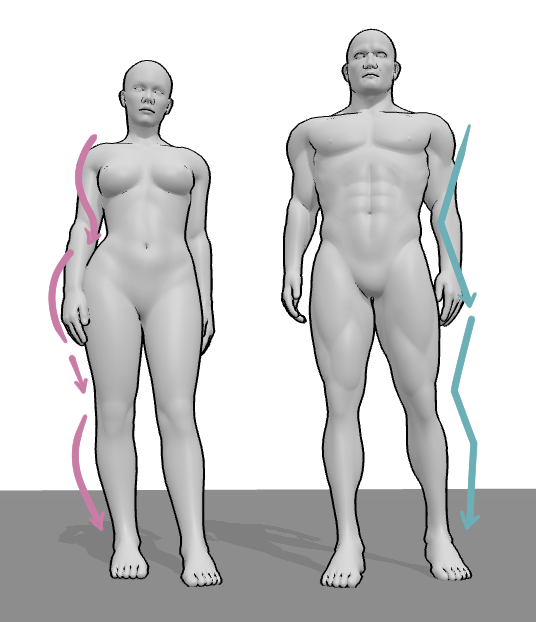 |
Female legs often emphasize smoother transitions between thigh and knee, with softer muscle definition and more continuous curves. Male legs typically show more pronounced structure, especially around the quadriceps, calves, and knee joints.
Muscle Groups That Actually Matter
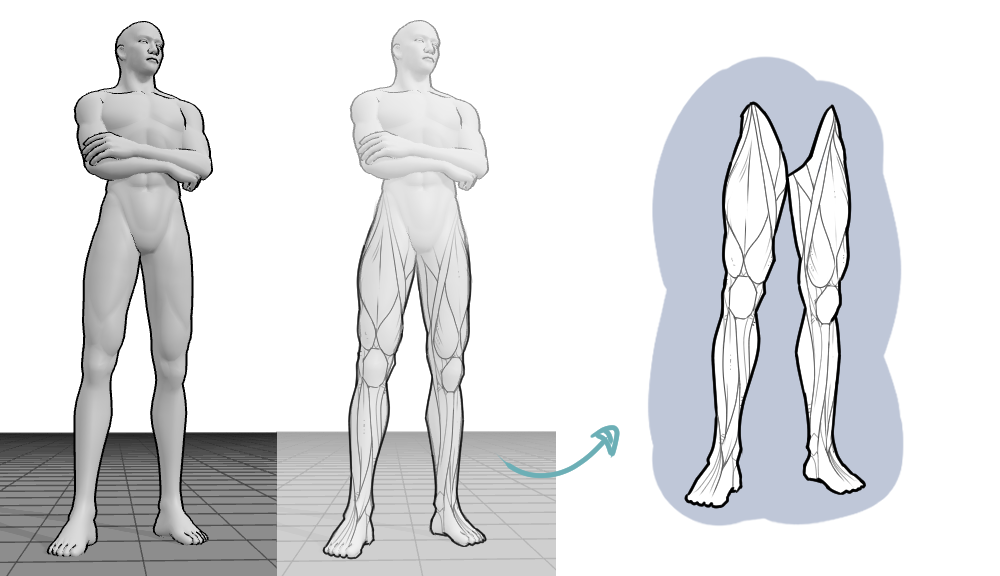
You don’t need to memorize every muscle to draw better legs. You need to understand the main forms that define the silhouette.
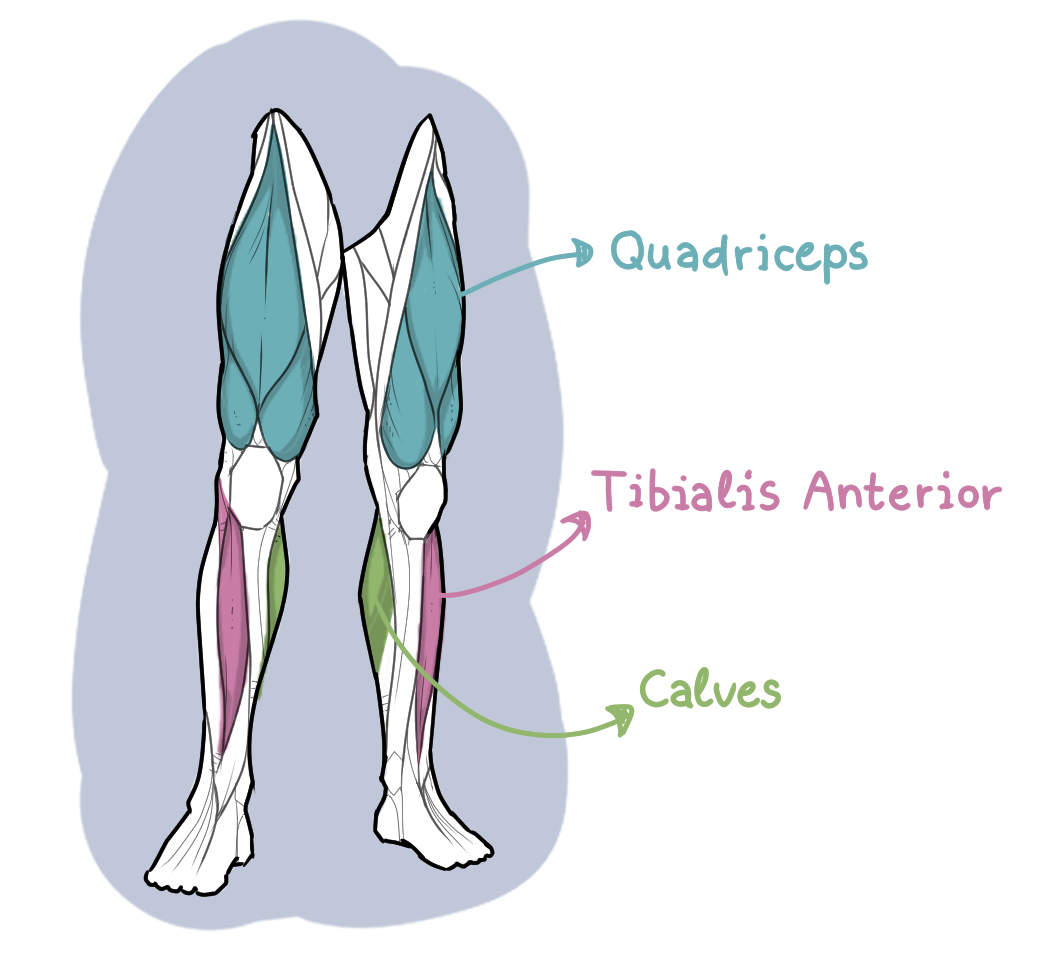
Front of the Leg
-
Quadriceps (front thigh mass)
Musculus quadriceps femoris -
Tibialis anterior / frontalis (shin structure)
Musculus tibialis anterior -
Calves (shape and tapering form)
Musculus triceps surae
(gastrocnemius + soleus)
|  |
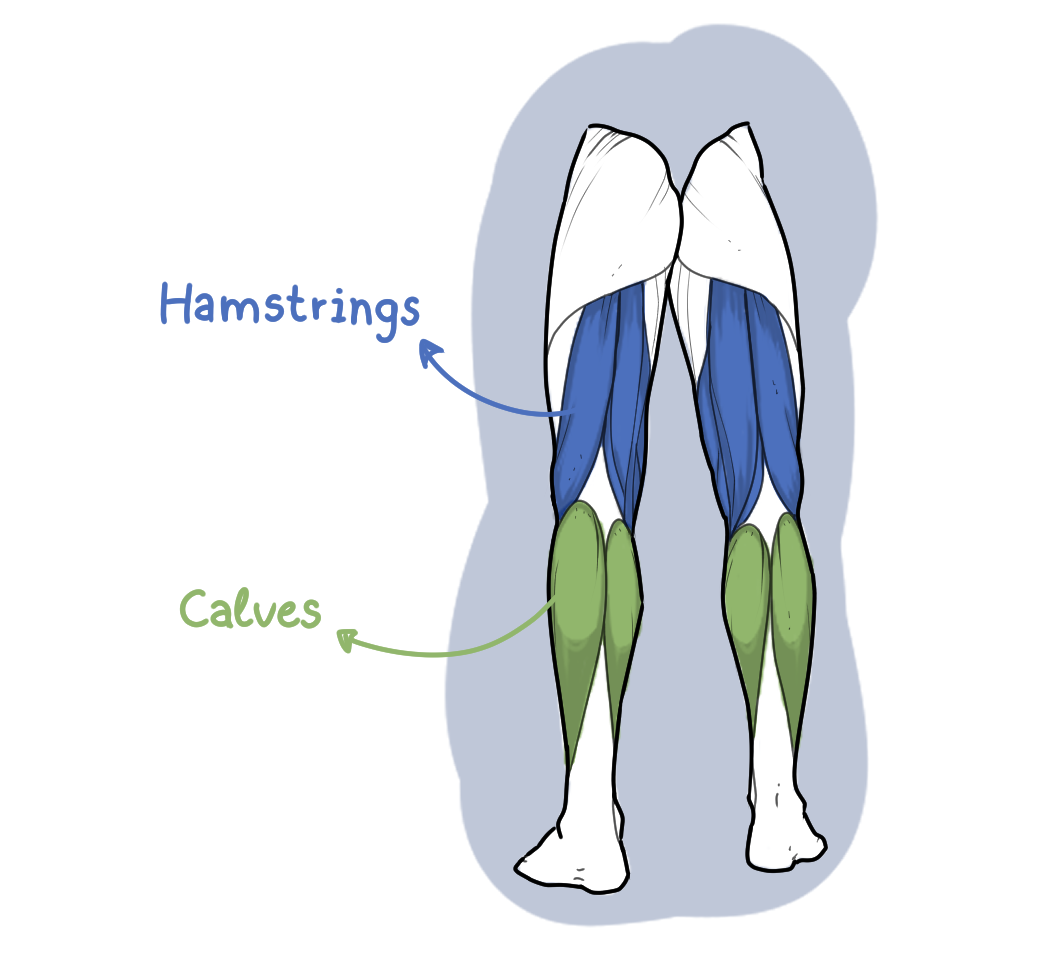
Back of the Leg
-
Hamstrings (back thigh balance)
Musculi ischiocrurales
(biceps femoris, semitendinosus, semimembranosus) -
Calves (shape and tapering form)
Musculus triceps surae
(gastrocnemius + soleus)
|  |
These groups are what actually shape the leg in motion and in rest.
The Knee: The Most Misunderstood Joint
The knee is not a simple hinge drawn as a circle. It is a structural transition point where:
- thigh mass narrows
- movement direction changes
- weight shifts through rotation
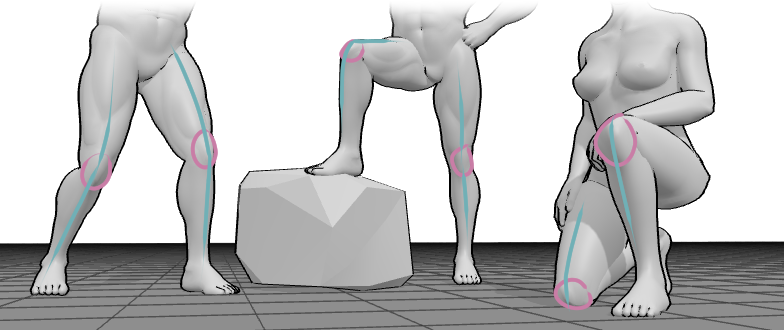
In 3D references, you can rotate the leg and immediately understand how the knee behaves differently in extension, bending, and twisting.
This eliminates one of the most common beginner mistakes: drawing knees as flat symbols instead of three-dimensional structures.
Feet and Ground Contact: Where Most Drawings Fail
A strong leg drawing is not complete without correct foot placement.
The foot is not just an add-on - it is the final transfer point of weight into the ground.
Key ideas:
- the heel anchors stability
- the ball of the foot absorbs forward pressure
- toes adjust balance dynamically
- the ankle connects tilt to body weight above
When feet are misaligned, the entire pose feels like it’s floating or slipping.
3D pose references make this immediately visible because you can see exactly how the foot presses into the ground plane from any angle.
How to Practice with 3D Pose References
Instead of copying, work like this:
Start with a 3D reference pose and break it into:
- simple mass shapes (thigh, calf, foot)
- center line of balance
- joint placement (hip, knee, ankle)
| 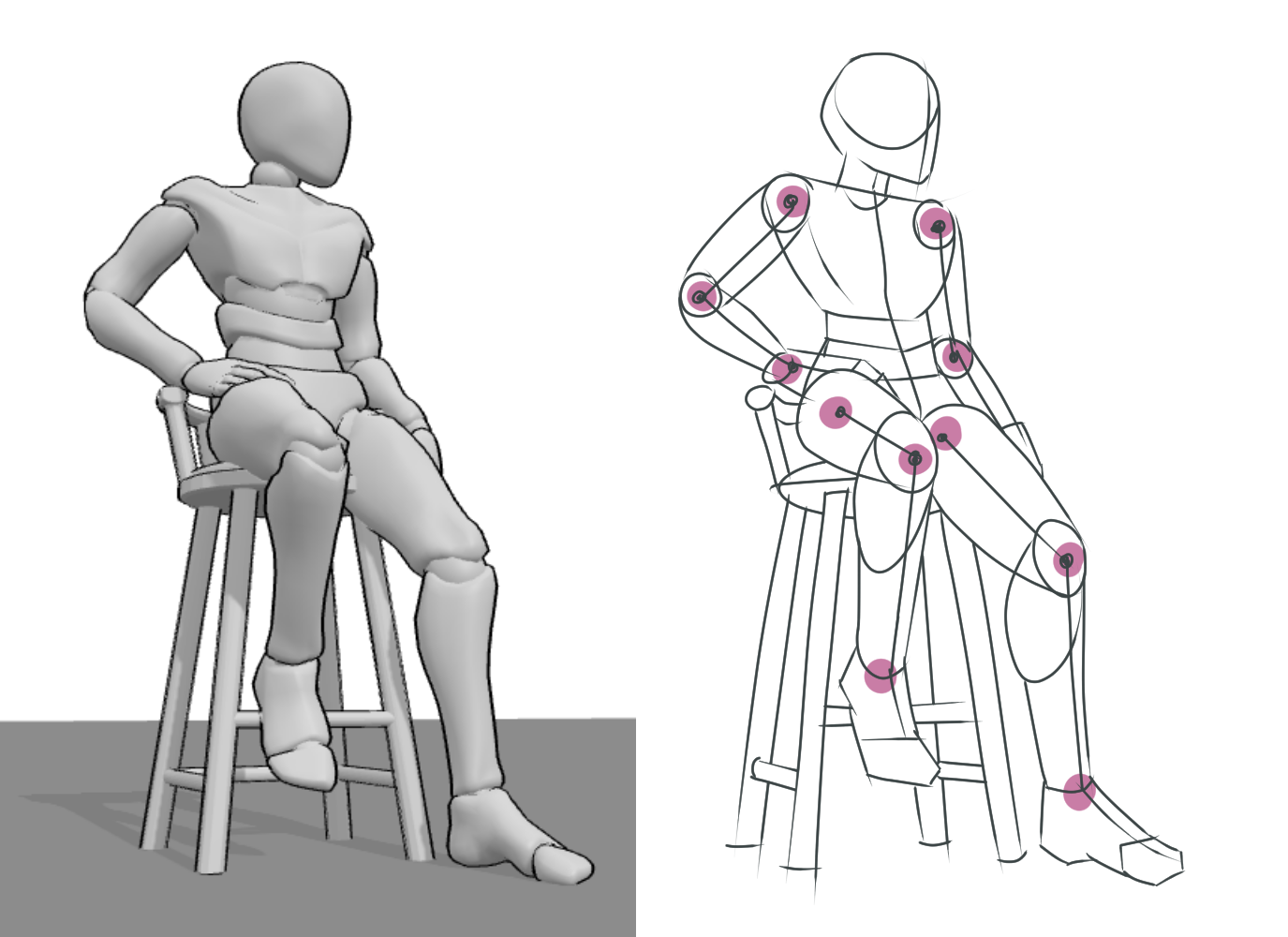 |
Then redraw it from understanding, not tracing.
| 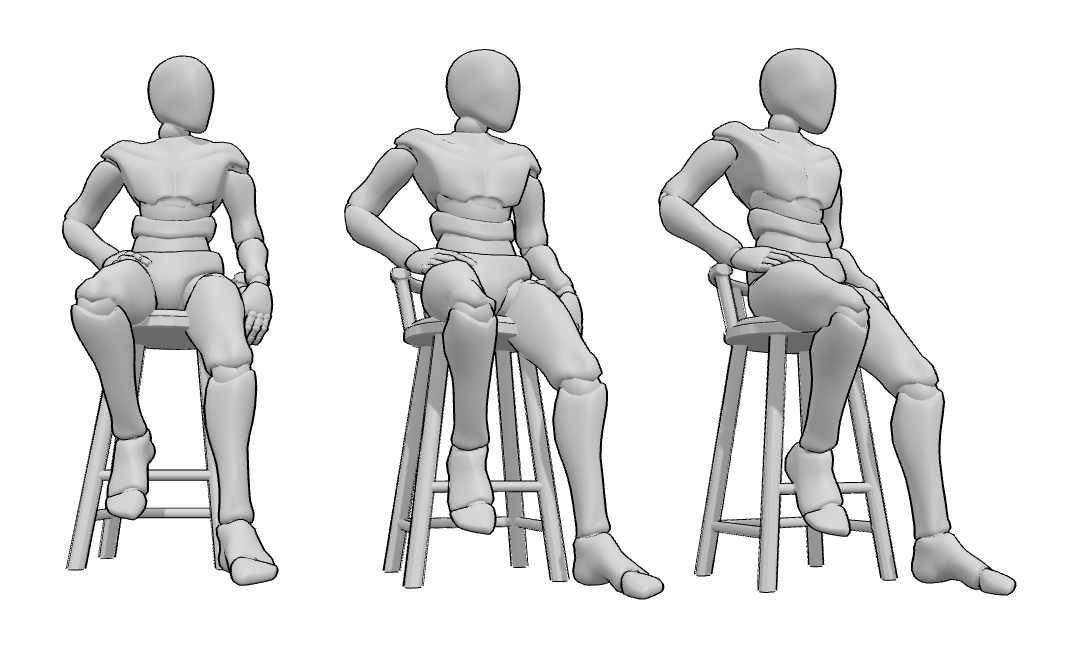 |
Rotate the same pose and study how structure changes with perspective. This is where real progress happens - not in repetition, but in variation.
Drawing-wise, the knee becomes much easier to understand when you study it across different sitting poses, knee sitting poses, crossed legs poses, legs drawing references, and many other variations, observing how its shape, angle, and visual weight shift as the body moves and balance changes.
Why This Method Works
Leg anatomy becomes difficult when you treat it as memorization.
It becomes manageable when you treat it as spatial logic.
3D pose references remove guesswork and replace it with observation. Over time, you stop thinking “how do I draw legs?” and start recognizing:
- where weight flows
- how joints connect
- how forms behave in space
That shift is what builds real drawing confidence.
Final Thoughts
Drawing legs is not about perfect anatomy knowledge. It’s about understanding structure in motion.
3D pose references don’t replace your skill - they reveal what you’re missing.
When you stop reconstructing legs from imagination and start studying them in space, everything becomes clearer: balance, proportion, and form all start to make sense.
And at that point, legs are no longer something you struggle with.
They become something you understand.